
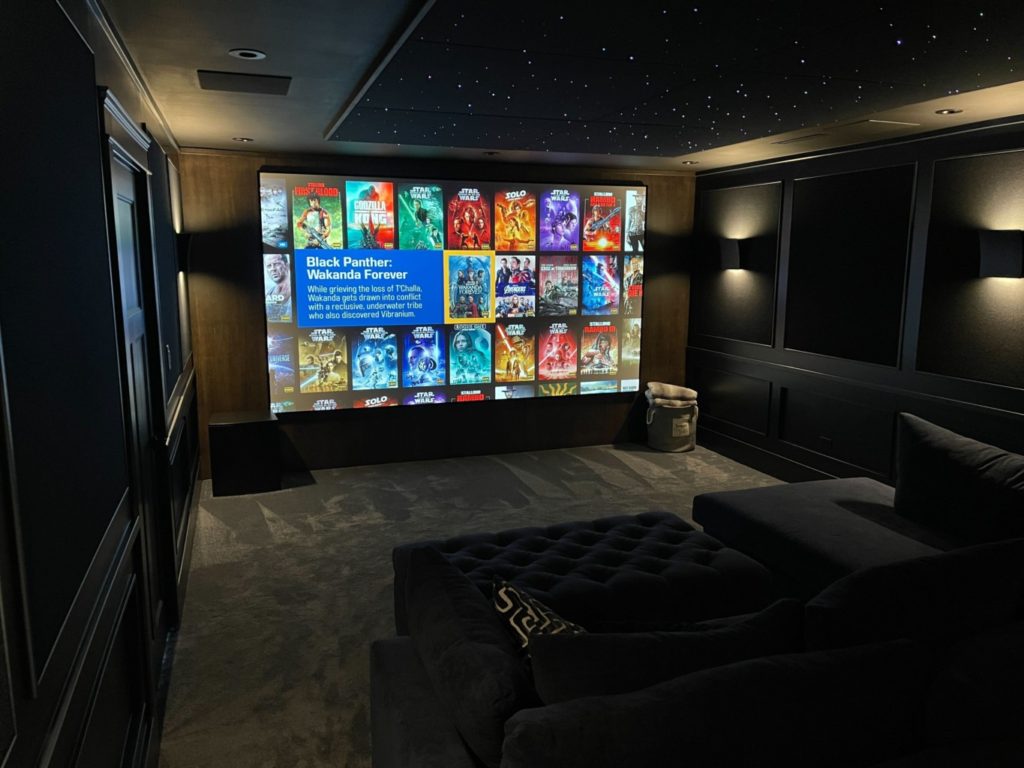
For most homes, streaming apps are enough.
For premium homes, they often fall drastically short.
As living spaces become more advanced, entertainment is no longer just about "having access to content." It is about absolute control, uncompromised quality, pristine reliability, and seamless integration. High-end homes increasingly treat media the exact same way they treat lighting, security, climate control, and networking: as a permanent part of the home’s infrastructure, not just a collection of plastic devices.
That is precisely where private media servers enter the equation.
A private media server gives homeowners centralized, local control over their movie library, TV shows, family videos, high-resolution music collection, and home content archives. Instead of depending entirely on third-party cloud platforms with fluctuating catalogs, a media server stores, organizes, and delivers content from enterprise-grade hardware that the owner actually controls.
Streaming apps absolutely still matter. They are convenient, culturally relevant, and excellent for discovery. But for premium homes, they are only one fractional part of the picture.
This guide explains the technical and practical differences between private media servers and streaming apps, and why the most advanced luxury homes are rapidly moving toward private media infrastructure.
What Is a Private Media Server?
A private media server is a dedicated hardware system (often running software like Plex, Emby, or Jellyfin) that stores media centrally and delivers it flawlessly over the home’s local network to compatible devices.
That media can include:
- Uncompressed 4K movie files (UHD Remuxes).
- Complete TV show archives.
- Lossless FLAC or ALAC music collections.
- Raw, unedited family videos and drone footage.
- Extensive photo libraries and personal archives.
The server itself may be a dedicated NAS (Network Attached Storage) device, a compact compute node, a full rack-mounted enterprise chassis, or a hybrid virtualization platform. The core philosophy is simple: the bits and bytes live on hardware the homeowner controls.
The system then transcodes and streams that content instantaneously to:
- High-end Smart TVs and OLED displays.
- Premium streaming boxes (like the Apple TV 4K or NVIDIA Shield).
- Mobile devices, tablets, and laptops.
- Dedicated, acoustically-treated home theater rooms.
- Remote family members with secure access permissions.
This creates a private, hyper-curated entertainment library rather than a rented, subscription-based catalog.
What Streaming Apps Actually Provide
Streaming apps are platforms that host and deliver heavily compressed content from the provider’s own global infrastructure.
The user does not own the storage. They do not manage the files. They do not control the encoding. They simply pay for temporary access to the catalog while the monthly subscription remains active.
This makes streaming apps extremely convenient, but that convenience comes with rigid limitations:
- Content licenses change constantly, meaning your favorite titles can disappear overnight.
- Quality is heavily compressed to save the provider money on bandwidth.
- Availability varies wildly by geographic region.
- Subscriptions stack up, leading to "streaming fatigue."
- Offline access is limited, highly restricted, and temporary.
- Ownership is an illusion; you are always renting.
For casual viewing in a standard living room, that is perfectly acceptable. For a meticulously engineered premium home, it is often a bottleneck.
The Core Difference: True Ownership vs Temporary Access
The most fundamental architectural difference between a private media server and streaming apps is ownership.
Streaming apps give you temporary access to a revolving catalog. A private media server gives you absolute ownership of a permanent library.
That ownership changes the entire dynamic of the home:
- Your collection is always available, even if the internet goes down.
- No platform or studio can ever remove, alter, or censor your files.
- Visual and audio quality is entirely under your control.
- Your interface and metadata can be customized beautifully.
- Family archives and irreplaceable home videos can be stored centrally and securely.
This is especially valuable for purists who care about curated content, long-term digital preservation, and reference-grade home theater experiences.
Why Premium Homes Care About Media Infrastructure
Luxury homes are not just larger homes; they are fundamentally more integrated environments. The technology should disappear, leaving only the experience.
A homeowner in a premium space expects:
- Exceptionally clean physical design (no visible wires or scattered hard drives).
- Seamless, instant access in every room.
- Minimal friction and unified user interfaces.
- Consistent, reference-grade quality.
A private media server fits that architectural model perfectly.
Instead of navigating ten different apps, managing ten different logins, and searching across ten different fragmented content libraries, the home centralizes all media delivery through one elegant, internal platform.
Uncompromised Video Quality Is the Biggest Advantage
Many people do not realize just how heavily streaming apps compress content. They do this to reduce their massive global bandwidth costs and to ensure streams don't buffer on weak cellular networks.
That aggressive compression works fine on a 50-inch TV. It falls apart completely on a 120-inch projection screen.
A 4K stream on Netflix or Disney+ typically maxes out at roughly 15 to 25 Mbps (Megabits per second). By contrast, a 4K UHD Blu-ray file stored on a private media server operates at 60 to 100+ Mbps.
That massive difference in data means a private server preserves:
- The organic, fine film grain originally captured by the camera.
- Perfect gradient transitions in dark scenes, completely eliminating "color banding" and macro-blocking (those ugly, blocky squares in the shadows).
- Peak HDR (High Dynamic Range) and Dolby Vision highlights without compression clipping.
In a dedicated theater room with calibrated reference displays, those compression artifacts become glaringly obvious. A private server ensures you are actually using the expensive display hardware you paid for.
Audio Quality Matters More Than Most People Think
While the general public focuses almost exclusively on video resolution, AV integrators know a secret: audio quality is what actually makes a home theater feel immersive.
Streaming apps fundamentally compromise audio. Even the best streaming services only provide "lossy" audio formats, typically Dolby Digital Plus (E-AC-3) with a highly compressed Atmos metadata layer.
A proper premium home theater is designed to support:
- Massive, uncompressed, multichannel audio.
- Lossless, high-bitrate tracks like Dolby TrueHD and DTS-HD Master Audio.
- Advanced architectural speaker setups (7.2.4 or 9.2.6 Atmos configurations).
- Dedicated, rack-mounted AV Receivers and discrete amplifiers.
Streaming apps simply cannot deliver lossless Dolby TrueHD. A private media server can. It passes the raw, uncompressed audio bitstream directly to the receiver, allowing the theater's acoustic engineering to perform exactly as intended. The dynamic range, the impact of the bass, and the clarity of the dialogue are in a completely different league.
Centralized Storage Is a Massive Quality-of-Life Upgrade
Without a dedicated infrastructure approach, personal content is usually scattered chaotically across iPhones, laptops, forgotten USB drives, external SSDs, iCloud folders, and random cloud backups.
For a premium home, that level of disorganization is a failure of infrastructure.
A centralized media server solves this by acting as the single, authoritative "Source of Truth" for everything important:
- Raw, uncompressed family videos.
- Personal photography collections and portfolios.
- Event recordings and security footage archives.
- Ripped movies and high-res FLAC music.
This makes content effortlessly easy to manage, infinitely easier to back up (following the 3-2-1 backup rule), and instantly accessible from any display in the house.
Multi-Room Access Is Where Private Infrastructure Shines
Premium homes rarely have just one viewing space. The environment usually includes a main living room, a master suite, a dedicated home theater, guest quarters, an outdoor entertainment pavilion, and perhaps a study.
A private media server synchronizes the entire estate.
That means:
- You have one central, meticulously organized collection.
- You can pause a movie in the theater and instantly resume it in the master bedroom.
- Metadata, watch history, and playlists are perfectly synchronized.
- Parents can enforce strict, profile-based access controls for children's rooms.
Instead of each room operating as its own isolated, frustrating ecosystem, the entire home becomes one coordinated, intelligent media environment.
Network Design Is the Unsung Hero
A media server is only as powerful as the network backbone carrying its data.
For premium homes, media infrastructure absolutely requires an enterprise-grade network designed properly from the ground up. If you are pushing 100 Mbps, uncompressed 4K files to three different rooms simultaneously, a standard consumer router will instantly choke.
Critical considerations include:
- A hardwired Cat6a or fiber backbone for all stationary, high-bandwidth devices (TVs, Apple TVs, Receivers).
- A robust, multi-VLAN enterprise switch topology (e.g., Unifi or Cisco).
- Proper network segmentation to keep heavy media traffic isolated from critical smart-home control protocols.
- Multi-gigabit (10GbE) uplinks between the NAS storage array and the primary switch.
If the network is weak, even a $20,000 media server will feel sluggish and broken. Media infrastructure must be architected concurrently with the home network.
Why Wi-Fi Alone Is Never Enough for Serious Media
Wi-Fi is a brilliant technology for convenience, but it is fundamentally a half-duplex, shared medium. It is not the correct transport layer for massive, high-bitrate media files.
For premium home theater systems and media rooms, hardwired Ethernet connections are mandatory because they provide:
- Near-zero latency.
- Guaranteed, un-fluctuating throughput.
- Total immunity to RF interference from appliances, neighboring networks, or thick concrete walls.
A well-designed media system intelligently routes heavy, uncompressed traffic over copper or fiber, leaving the Wi-Fi spectrum completely clear for mobile devices and tablets.
Streaming Apps Are Still Highly Useful
Building private infrastructure is not a philosophical argument against streaming platforms. Streaming services remain excellent for:
- Discovering brand new content and original series.
- Supreme on-demand convenience when traveling.
- Live event broadcasts and sports.
- Casual, background watching.
The most practical, luxurious model is always hybrid:
- Use streaming apps for discovery, casual viewing, and daily convenience.
- Use a private media server for absolute ownership, flawless archival playback, and reference-grade theater experiences.
That combination gives the home the ultimate best of both worlds.
The Role of the NAS in a Media Setup
A NAS (Network Attached Storage) forms the physical foundation of a private media system. It is the vault.
It utilizes advanced file systems like ZFS and redundant drive arrays (RAID) to ensure that even if a physical hard drive dies, zero data is lost. In many premium homes, a massive 8-bay or 12-bay NAS serves purely as the permanent storage layer, while a separate, high-powered compute node handles the actual Plex/Emby media processing and streaming.
That architectural separation (storage vs compute) improves flexibility, increases system lifespan, and allows the home's capabilities to scale up without ever having to rebuild the foundation.
Final Thoughts
Streaming apps democratized access to content, but they homogenized the quality.
Private media servers restore control.
For premium homes, the best answer is understanding what each paradigm does best. Rely on streaming for broad, frictionless access to licensed content. But rely on a private media server for absolute ownership, reference-grade quality, generational preservation, centralized local storage, and a vastly superior, multi-room entertainment experience.
As homes become more deeply integrated and personalized, media stops being an app you download. It becomes a fundamental piece of the property's infrastructure.
For the right home, a private media server isn't a luxury—it is simply the correct engineering design.