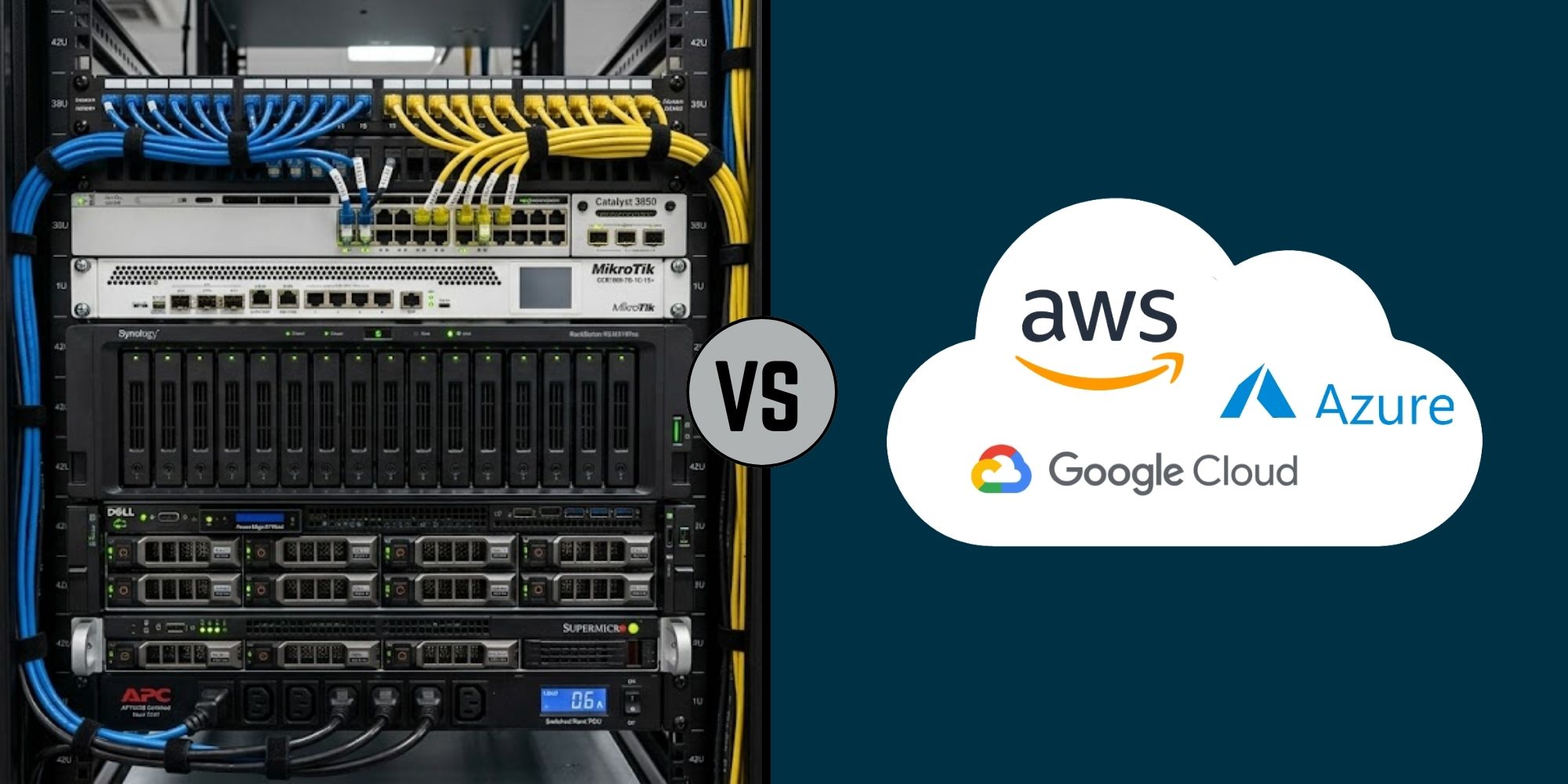
Cloud computing solved a very real, very painful problem of the 2010s. It made it possible for startups and enterprises alike to launch applications instantly without ordering servers, waiting weeks for shipping, hiring a full datacenter team, or worrying about rack space on day one.
But the cloud is not automatically the best architectural answer for every workload.
At some point in a company's growth, usually when the AWS or Azure bill crosses a certain painful threshold, businesses discover a hard truth: what looks incredibly simple and cheap at the beginning can become financially restrictive, heavily locked-in, and operationally messy as usage scales. That is exactly when private infrastructure stops being an "old IT" concept and becomes a massive competitive advantage.
The famous tech industry phrase "the cloud is just someone else’s computer" is memorable because it is technically absolute. You are still executing code on silicon, routing packets through switches, spinning physical storage drives, and generating heat that requires cooling. The only difference is that someone else owns the hardware—and they are charging you a massive premium to rent it.
That rental model is excellent for solving some problems. It is wildly inefficient for solving others.
This article explains when private infrastructure actually wins, what "private" means in the context of modern engineering, and how to think about the CAPEX vs OPEX tradeoffs with a clear, technical lens.
What Private Infrastructure Actually Means Today
Private infrastructure is any computing environment that you explicitly own, control, or dedicate exclusively to your own workloads, rather than sharing resources inside a cloud provider’s hyper-scaled, multi-tenant platform.
It can include:
- A high-density server rack sitting in an on-premises server room.
- A private cloud stack running on hardware you own, hosted in a colocation datacenter.
- High-performance Edge appliances deployed directly at branch offices.
- Enterprise NAS and SAN storage systems.
- Dedicated GPU clusters for private AI training.
- Internal virtualization clusters (like Proxmox or VMware) built around your own compute nodes.
Private infrastructure does not mean "old-fashioned," "less capable," or "hard to use." In modern deployments, private infrastructure is built using the exact same containerization (Kubernetes), infrastructure-as-code (Terraform), and automation tools used in the public cloud. It is simply more specialized, highly predictable, and vastly more cost-efficient for the right use cases.
Why the Public Cloud Became Dominant
The public cloud became the default answer for modern IT because it removed friction.
Instead of dealing with capital expenditure (CAPEX) and hardware procurement, an engineer could simply run a script and:
- Provision 50 servers instantly.
- Scale down to 2 servers the next day.
- Test new architectural ideas for pennies.
- Avoid managing physical network cables or failed RAM sticks.
That elasticity is absolutely perfect for:
- Startups validating a product with zero initial users.
- E-commerce platforms with highly variable, seasonal traffic (like Black Friday spikes).
- Global applications requiring instant presence in 15 different countries.
Public cloud is unparalleled when time-to-launch and elasticity matter more than long-term infrastructure efficiency.
The financial trap begins when "temporary operational convenience" quietly becomes your permanent, inescapable architecture.
The Hidden Costs of Cloud Adoption
Cloud bills rarely stay simple, and they almost never go down.
The initial appeal is obvious: no upfront capital expense, no local IT setup, and no datacenter lease. But as your data gravity increases, the micro-transactions begin to pile up exponentially:
- Compute (EC2) Charges: You are paying for the CPU by the second, 24/7/365.
- Storage (EBS/S3) Charges: You are billed not just for the gigabytes, but often for the Provisioned IOPS (input/output operations per second) to make that storage fast.
- Bandwidth Egress: This is the silent killer. AWS famously makes it free to upload your data, but charges exorbitant rates (often $0.09 per GB) for that data to leave their network.
- Managed Services: Managed databases (RDS), load balancers, and NAT Gateways all carry hourly premiums simply to exist.
The cloud is marketed as pay-as-you-go. In reality, for most production systems, it becomes pay-forever.
For steady, predictable workloads, this matters immensely. A high-end 1U enterprise server that costs $15,000 to purchase outright might cost your company $60,000 to rent over three years in the public cloud. The cloud may be cheaper on day one, but it is brutally expensive to sustain on day one thousand.
When Private Infrastructure Wins Decisively
Private infrastructure tends to win when one or more of the following are true:
1. Predictable Workloads Favor Owned Hardware
A consistent, 24/7 workload is the strongest financial argument for private infrastructure.
If your application uses roughly the same amount of compute every day, the entire economic argument for "cloud elasticity" disappears. You are continuously paying a premium for the ability to scale, even though you never actually do.
Examples include:
- Active Directory and internal authentication servers.
- Render nodes for VFX and animation.
- AI inference machines for internal chatbots.
- Heavy database backends with consistent daily queries.
- Video surveillance and massive NVR storage arrays.
These systems do not need to scale from 1 to 100 servers in an hour. They just need to run reliably. When the workload is a flat line, owning the hardware is always the mathematically superior choice.
2. Data-Sensitive Workloads Require Absolute Control
Privacy is not a marketing slogan; it is a fundamental architectural boundary.
If your data includes:
- Proprietary source code.
- Unreleased CAD and engineering designs.
- Untrained or fine-tuned AI models that represent your company's core IP.
- Strictly regulated medical or financial records.
...then every external API and third-party dependency introduces risk. While public clouds are highly secure, they are still multi-tenant environments. You are relying on the hypervisor to isolate your data from the competitor running a virtual machine on the exact same physical CPU.
Private infrastructure gives you:
- Complete physical sovereignty over where the data lives.
- The ability to literally pull the network plug if a breach is detected.
- Isolated, air-gapped network boundaries.
- Zero reliance on third-party security patches.
3. Latency-Sensitive Applications Perform Better Close to Home
The farther your compute is from the user, the more the speed of light and network hops dictate your latency.
A regional private deployment or on-premise edge server can reduce delay down to sub-millisecond levels compared to routing traffic to a distant us-east-1 datacenter.
This is critical for:
- Industrial manufacturing control systems.
- Live media broadcasting and video editing workflows.
- Real-time CAD collaboration.
- High-frequency trading algorithms.
- Localized AI voice assistants where conversational delay ruins the experience.
For these applications, a private server sitting in the same building as the users will fundamentally outperform a multi-million-dollar cloud cluster, simply because the round-trip ping is shorter.
4. Bandwidth and Egress Can Become a Lethal Tax
As mentioned earlier, cloud providers make it easy to upload data, but they penalize you heavily for downloading it.
This becomes financially devastating when you regularly move:
- 8K raw video assets.
- Nightly terabyte-scale backups.
- Machine learning datasets for local testing.
- Massive architectural BIM models.
If your business constantly moves heavy data in and out of the cloud, your egress bill can quietly eclipse your compute bill. By shifting to private infrastructure (like an on-premise NAS with a 10GbE local network), you eliminate external transfer costs entirely. Your team can move 50 Terabytes a day for the cost of the electricity to run the switch.
5. Specialized Hardware is Easier to Justify Privately
The public cloud offers specialized hardware, like NVIDIA H100 or A100 GPU instances, but they are astonishingly expensive to rent—often $10 to $30+ per hour.
If your engineering team needs a GPU server for continuous AI training, or a Threadripper PRO workstation for rendering, renting that compute in the cloud will burn through your IT budget in weeks.
Owning a dedicated $30,000 AI server might sound expensive until you realize it pays for itself in exactly 4 months of avoided cloud fees. Furthermore, a dedicated local machine can be repurposed across many workloads over its 5-year lifespan, driving the Return on Investment (ROI) through the roof.
The Cloud is Still the Right Answer Sometimes
Advocating for private infrastructure does not mean the public cloud is useless. The cloud still absolutely wins when you need:
- Rapid, low-risk experimentation for new product lines.
- Global CDN distribution to serve users in Asia, Europe, and America simultaneously.
- Highly variable, unpredictable web traffic.
- Immediate disaster recovery failovers to entirely different geographic regions.
If your team is 3 people, and no one knows how to configure a RAID array, manage server cooling, or replace a dead power supply, the cloud abstraction is worth the massive financial premium.
The key is knowing exactly when that premium stops being justified.
CAPEX vs OPEX: The Real Business Tradeoff
Ultimately, the technical decision heavily mirrors the financial decision.
CAPEX (Capital Expenditure)
Buying hardware upfront. You purchase servers, switches, and UPS batteries.
- Pros: Highly predictable long-term costs, absolute physical control, massive savings over 3-5 years, zero recurring software subscription lock-in.
- Cons: Requires upfront cash, requires physical planning (power/cooling), and puts hardware maintenance on your team's shoulders.
OPEX (Operating Expenditure)
Renting infrastructure. You pay AWS, Azure, or Google Cloud a monthly bill.
- Pros: Zero upfront cost, instantly deployable, easy to scale down if a project fails.
- Cons: You are paying a perpetual margin to the provider. The monthly bill is highly susceptible to "cost creep" as engineers spin up resources and forget to turn them off.
For mature businesses with steady workloads, shifting from OPEX to CAPEX is one of the most effective ways to instantly increase company profitability.
Hybrid is Often the Smartest Architecture
For the vast majority of growing enterprises, the best answer is not pure private or pure cloud. It is a strategically engineered Hybrid approach.
A well-designed Hybrid infrastructure might look like:
- Keeping massive databases, secure file storage, and active AI training on high-performance private servers.
- Using the public cloud purely to host the lightweight web-frontend that requires global load balancing.
- Utilizing cloud object storage (like AWS S3) strictly as an immutable, off-site disaster recovery target for your local NAS.
Hybrid gives you the absolute performance and cost-control of owned hardware, while retaining the burst elasticity of the cloud when you actually need it.
Final Thoughts
The cloud is incredibly useful, and for many businesses, it is the only logical place to start. But as systems mature, data sets grow, and workloads stabilize, the cloud is rarely the most practical place to stay.
Private infrastructure wins when your workloads are predictable, your data is highly sensitive, network latency matters to your users, and long-term financial efficiency matters to your board.
It is not about aggressively rejecting the cloud. It is about understanding the fundamental mechanics of computing, and knowing exactly when ownership becomes a better strategy than renting forever.
The cloud will always just be someone else's computer. At a certain scale, it pays to build your own.